- Human Infrastructure
- Posts
- Human Infrastructure 428: A Manifesto for a Better Internet, Getting Cisco on Proxmox, and More
Human Infrastructure 428: A Manifesto for a Better Internet, Getting Cisco on Proxmox, and More


Ethan Banks & Drew Conry-Murray
December 11, 2025
THIS WEEK’S MUST-READ BLOGS 🤓
The Resonant Computing Manifesto - Resonant Computing
https://resonantcomputing.org/
Prior to AI, the Internet had already become highly centralized. Tech and business culture devoted itself to hyper-scale growth and to building systems that didn’t serve end users so much as serve them up as extractable sources of attention, commerce, and data. As we continue down this path, AI has the potential to exacerbate centralization and extraction.
The Resonant Computing manifesto wants tech to take a different the path. It describes five principles that can guide developers, builders, and businesses towards building ecosystems that nourish rather than extract, inform rather than lure, and help us create meaningful lives.
The skeptic in me is rolling my eyes at the notion of a manifesto. But if you want something to change, you actually have to say it, and then work for it. Maybe they’re on to something here. - Drew
Ghostty Is Now Non-Profit - Mitchell Hashimoto
https://mitchellh.com/writing/ghostty-non-profit
After the drama surrounding Terraform licensing changes, I find myself oddly emotional about this post from Mitchell. I get the sense that what happened previously wasn’t his doing, and he’s going to make sure it doesn’t happen again. Hard to say. I don’t know the back story as much as the fallout that ensued.
“Second, I want to squelch any possible concerns about a "rug pull". A non-profit structure provides enforceable assurances: the mission cannot be quietly changed, funds cannot be diverted to private benefit, and the project cannot be sold off or repurposed for commercial gain. The structure legally binds Ghostty to the public-benefit purpose it was created to serve.”
Although I’m not a Ghostty user myself, I appreciate what Mitchell is doing with the project. - Ethan
How to Set Up a Cisco 9800-CL Wireless Controller on Proxmox Without Losing Your Mind - Adjacent Node
https://www.adjacentnode.com/post/how-to-set-up-a-cisco-9800-cl-wireless-controller-on-proxmox-without-losing-your-mind
Kevin Nanns addresses the bad information making it difficult go bring up the Cisco 9800-CL on Proxmox.
“If you’ve ever tried getting a Cisco Catalyst 9800-CL running on Proxmox, you already know what happens: nothing works, every blog you find is half-wrong, Cisco’s documentation contradicts itself, and you start questioning every career decision you’ve made since high school.
So here’s the real guide, the one I wish existed before I wasted an afternoon fighting UEFI, corrupt ISOs, and “why the hell is this bootloader frozen?” moments. This is the setup that actually works.”
If you’ve got this problem, Kevin is there to walk you through identifying the correct image, working VM settings, looking at the right output, and more along with typical failures he’s seen pop up. - Ethan
MORE BLOGS
One too many words on AT&T's $2,000 Korn shell and other Usenet topics - Gábor Nyéki
Banning VPNs - Schneier On Security

MeterUp 2025 brought together some of the sharpest minds in networking—leaders like Bob Metcalfe, Satya Nadella, and others shaping how networks are being built today.
You can now stream the mainstage sessions on demand.
Highlights include:
9 new hardware platforms announced
Our new WAN to LAN partnership with Lumen
Hear how Reddit, Lyft, and Nurix use Meter
TECH NEWS 📣
Oracle shares slide on $15B increase in data center spending - Ars Technica
https://arstechnica.com/information-technology/2025/12/oracle-shares-slide-on-15b-increase-in-data-center-spending/
Oracle wants to play catch-up in AI to rivals such as Microsoft and Google. To do that, it has to spend money on infrastructure. But some shareholders may be getting wary of all the money going into AI without much revenue or profit coming out the other side.
From the article: “Oracle stock dropped after it reported disappointing revenues on Wednesday alongside a $15 billion increase in its planned spending on data centers this year to serve artificial intelligence groups.” - Drew
Short memory supply forces Micron to abandon consumer market, prioritize enterprise - NetworkWorld
https://www.networkworld.com/article/4102592/short-memory-supply-forces-micron-to-abandon-consumer-market-prioritize-enterprise.html
Crucial is going away, and I’m a little sad. Crucial was my go-to for memory when building PCs and servers. Once upon a time, they had what no one else had—a series of drop-downs so you could find exactly the types of memory that would be compatible with your build. They took the uncertainty out of spec’ing memory.
But alas, Micron believes there’s more money to be made feeding the AI data center monster. I’m sure they’re right. - Ethan
RAM scalping takes hold on eBay, some DDR5 selling for more than $2,000 - Tom’s Hardware
https://www.tomshardware.com/pc-components/ram/ram-scalping-takes-hold-on-ebay-some-kits-selling-for-more-than-usd2-000-price-gouged-kits-fetch-7x-their-original-value-adding-almost-double-the-markup-on-already-inflated-prices
In a related story to the one above, with RAM makers focusing on the server market and depriving the consumer market, some online entrepreneurs (or scalpers, depending on which side of the deal you’re on) are taking advantage of demand to jack up prices on memory products. - Drew
MORE NEWS
Aviz Networks launches enterprise-grade community SONiC distribution - NetworkWorld
Intel decides to keep networking business after all - NetworkWorld
FOR THE LULZ 🤣

In case you have any remodeling plans on the books for 2026. Shared on LinkedIn by Adam.
RESEARCH & RESOURCES 📒
Kirk Byers is offering a free 10-week Python course aimed at network engineers. It started December 9th but is still currently available. It’s conducted via email, so you don’t have to worry about having missed a lesson. - Drew
Git Essentials (for Network Engineers!) | Learn To Code Using AI Course - Erika the Dev via YouTube
https://www.youtube.com/watch?v=-tJkOhRf1Qs
Erika Dietrick reports on LinkedIn, “Not perfection, but all of Level 1 is now available 🙌 Git Essentials For Network Engineers. Stay tuned for future announcements, including start of Level 2! In Level 2, we introduce AI for learning.”
Several other “for network engineers!” videos on Erika’s channel. Worth a sub! - Ethan
gping: ping, but with a graph - orf via GitHub
https://github.com/orf/gping
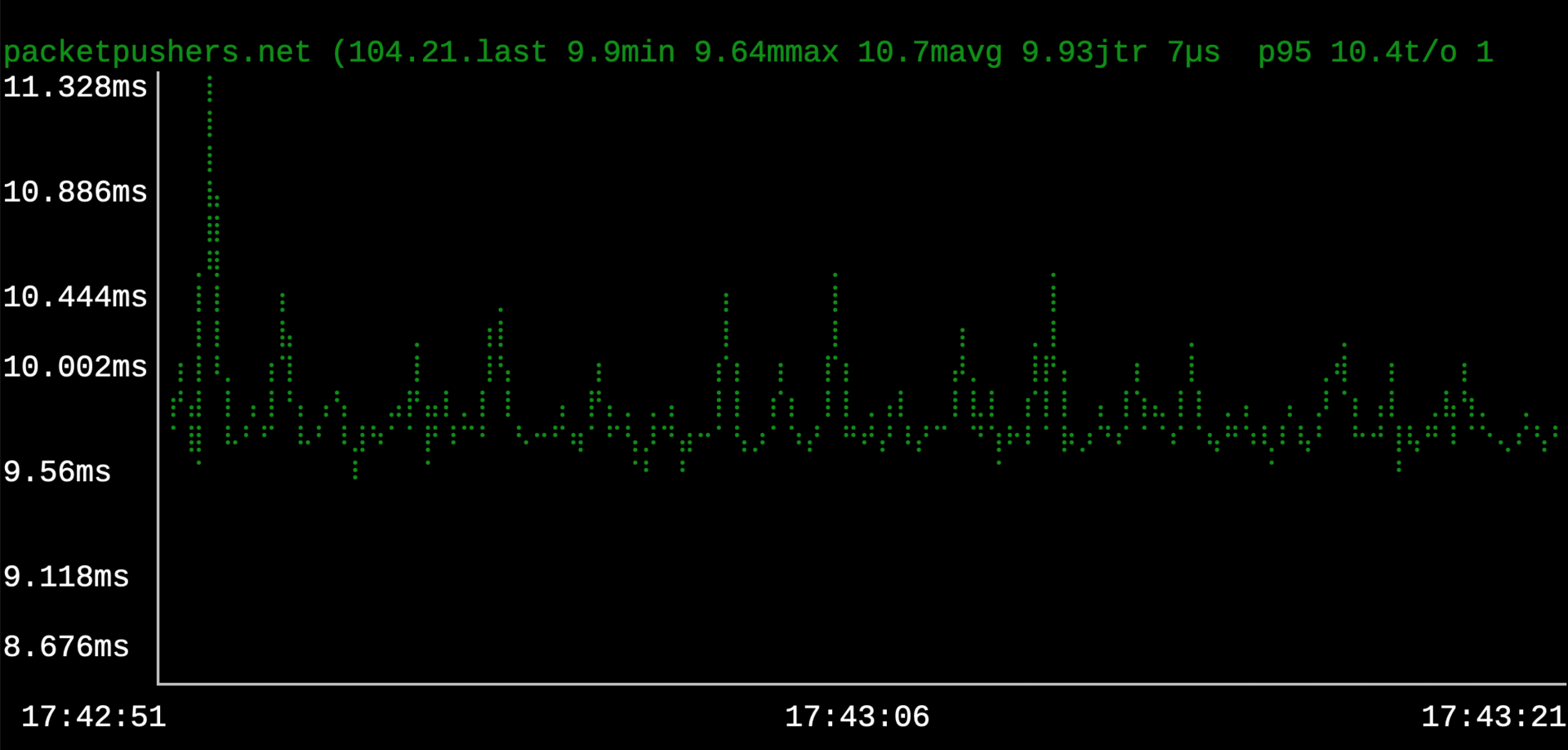
Cool! - Ethan
tier6 - jorisvink via GitHub
https://github.com/jorisvink/tier6
From the README. “Build a global ethernet network using sanctum p2p e2ee tunnels. Tier6 uses the sanctum protocol and its cathedrals to autodiscover peers in the same flock and establish p2p e2ee tunnels to each peer in full mesh mode. All incoming traffic is dumped into a single tap interface. Return traffic is only sent to peers on which the destination MAC address has been seen as a source earlier, acting like a soft-switch.”
Lots of open source tools out there that provide a similar outcome, but perhaps this particular flavor of overlay network appeals to you. - Ethan
Interesting: an MCP Agent for Link-State Routing Protocols - ipSpace.net
https://blog.ipspace.net/2025/11/mcp-agent-link-state-protocols/
Ivan Pepelnjak reports, “Vadim Semenov created a nice demo that allows you to use an LLM to query the collected link-state graphs through an MCP agent (SuzieQ would probably be faster and easier to deploy, but hey, AI).
If you want to kick the tires, you’ll find the source code on GitHub (Network AI assistant, MCP server for Topolograph service). You’ll also need Vadim’s previous projects: Topolograph and OSPF watcher or IS-IS watcher.”
Enjoy experimenting! - Ethan
MORE RESOURCES
Talk to Your Network. Get Answers. Fast.
Meet Ask EDA, your AI-powered assistant for data center automation.
What if managing your network was as easy as having a conversation? With Ask EDA, it is.
Powered by Nokia Event-Driven Automation (EDA), Ask EDA is your always-on AIOps assistant, designed to help you troubleshoot, explain and resolve issues before they ever reach production.
No more late-night log dives. No more frantic bridge calls. No more searching endless documentation.
Ask EDA sees the network in real time, understands what’s happening, and tells you in plain language what went wrong, why it happened, and how to fix it. From YAML errors to dropped BGP sessions, it doesn’t just point fingers. It shows you the fix that you test in our integrated digital twin.
Ask EDA is the smartest network engineer you’ll never have to wake up.
Explain alarms. Investigate outages. Build dashboards on demand. Just ask.
…and see what’s possible when AIOps meets intent-based automation.
INDUSTRY BLOGS & VENDOR ANNOUNCEMENTS 💬
Beyond RC4 for Windows authentication - Microsoft
https://www.microsoft.com/en-us/windows-server/blog/2025/12/03/beyond-rc4-for-windows-authentication
Microsoft is deprecating the use of RC4 in its Kerberos implementation in Windows. One reason they held onto it so long was for backwards-compatibility, but the liability of RC4 now outweighs compatibility. (Well, more or less. See the second paragraph.) Starting in the middle of 2026, RC4 will be disabled by default, and Windows Server 2008 and later will only allow the use of AES-SHA1. The post notes “If existing RC4 use is not addressed before the default change is applied, authentication relying on the legacy algorithm will no longer function.”
If, for whatever reason, you must still use RC4, a domain administrator will have to configure it explicitly. The post linked above has information to help you find out if RC4 is still used or allowed in your environment, and how to change that. - Drew
Arista Introduces Massive Scale Campus Mobility - Arista Networks
https://www.arista.com/en/company/news/press-release/22998-pr-20251210
Arista has dropped three significant announcements for wireless, AI, and switching into a single press release. They are:
The ability to deploy large-scale wireless roaming that can support up to 30,000 APs and 500,000 clients in a single domain
New capabilities for its AVA AI chat assistant
Its first-ever ruggedized access switches for industrial and outdoor uses
Of particular interest to me is the wireless announcement. Arista tends to land enterprise customers with its data center products. From that vantage, it sees the opportunity to extend into the campus and WAN. This latest WLAN announcement is a manifestation of that vision.
Arista has achieved this large-scale mobility domain using EVPN VXLAN. Aimed at campus-wide deployments, factories and warehouses, and public venues, this new mobility domain offering doesn’t require a controller. Instead, the APs use VXLAN to tunnel all their traffic to WLAN gateways, which are Arista switches. These switches use EVPN to create a Layer 2 fabric that provides a single wireless domain among thousands of APs and can encompass a large physical area. Arista says that it supports third-party switches at the access layer; for example, you can use Arista APs and connect them to Cisco or another vendor’s access switches, which would then be tied into the Arista WLAN gateway switches. More details about all three announcements are available in the press release linked above, and this company blog. - Drew
Lightyear Expense Management: The first AI-native system to automate telecom billing and payments - Lightyear
https://lightyear.ai/product-updates/lightyear-expense-management-the-first-ai-native-system-to-automate-telecom
Lightyear, which makes a SaaS platform to manage and automate telecom procurement, inventory management, and other functions, has announced a new expense management feature. Telecom bills can be opaque, and parsing those bills to track expenses and make sure you’re only paying for the services being delivered is often a manual and tedious process.
Lightyear’s Expense Management feature aims to automate this process. It can ingest telecom bills in multiple formats (PDF, EDI, Excel/CSV, API, and physical mail), normalize line items so that charges are clear even across multiple providers, and track ongoing costs.
Lightyear can also match bills and services against your actual telecom inventory, which Lightyear already tracks and manages as part of its SaaS offering. The service can audit bills to look for errors, such as still being charged for a service you disconnected, or being charged the wrong rate for a service.
Lightyear says it uses AI in two ways for its Expense Management feature. First, AI is used to extract and normalize all the information in telecom bills. Second, there’s an LLM feature that lets you use natural language to ask questions about bills and generate reports. - Drew
The Android Show: New features for Galaxy XR and a look at future devices - Google
https://blog.google/products/android/android-show-xr-edition-updates/
Glassholes are back, baby! Google, not wanting to leave the market of creepy dudes and creepy law enforcement agents all to Meta, has announced it’s bringing back Google Glasses. This time around they are called AI glasses, because, duh. The glasses include “built-in speakers, microphones and cameras to let you chat naturally with Gemini.” There will also be an advanced option with an in-lens display that “privately shows you helpful information.”
Google Glass failed last time around in part because enough people were weirded out by the idea of surreptitious surveillance that the public could shame Google into pulling the product. But attitudes change. This time around, Google may be betting that notions of propriety or personal boundaries have sloughed off after another dozen years or so of our culture soaking in a social media ethos that prioritizes visibility above all things. - Drew
AWS and Google Cloud collaborate to simplify multicloud networking - AWS Networking & Content Delivery Blog
https://aws.amazon.com/blogs/networking-and-content-delivery/aws-and-google-cloud-collaborate-to-simplify-multicloud-networking/
This is quite the collaboration considering that not all that long ago, AWS seemed to deny that other clouds even existed. So what’s on offer here?
A cloud-native approach to intercloud connectivity.
Dedicated bandwidth between clouds on-demand—lit up in minutes.
Want to know more? AWS Interconnect documentation. Google Cross-Cloud Interconnect (Demo 2) via YouTube. - Ethan
Proxmox Datacenter Manager 1.0 available - Proxmox Press Releases
https://www.proxmox.com/en/about/company-details/press-releases/proxmox-datacenter-manager-1-0
PDM 1.0 is—more or less—VMware vCenter for Proxmox. Well, it’s less at the moment. Yes, it’s an umbrella manager for your Proxmox environment. Sure, there are global views you get and a good start on that single pane of glass feel. But hey, it’s 1.0. Lots of read-only functionality at this point and tasks you’ll have to jump out to specific Proxmox Virtual Environment servers to accomplish. And the UI is…fine. It works, and it’s logical. It ain’t pretty, but neither it is ugly.
For those unwilling to pay modern Broadcom VMware pricing, PDM 1.0 suggests that Proxmox wants your business. No, it’s far from a 1:1 replacement for the VMware world. But you can see where they’re going.
The best overview video I found covering an earlier PDM beta is here. - Ethan
20 Gig: How our 25G PON investment shatters the limits of today's internet - Google Fiber Blog
https://fiber.googleblog.com/2025/12/20-gig-update.html
Such a breathless headline. We’re shattering limits here, folks! Sigh. Don’t get me wrong. 20Gbps symmetrical to your house is pretty awesome, and the GOOG had to figure some stuff out to make it happen. 20Gbps is a LOT of last mile pipe to support at scale.
“The deployment of this new, next-generation ONT is the key to unlocking that capacity for the home and enabling us to serve customers more broadly than ever before. It also means upgrading the experience for those already on the journey with us; we have several 20 Gig early access customers today, and we will be automatically upgrading them to this new hardware. As we ramp up operations for this new ONT, we expect to move 20 Gig out of our early access program and into a generally available product next year. That’s a really big deal!”
Breathless headline aside, I like this product not only because more bandwidth is…more…but also because it helps contextualize what actual broadband bandwidth should be as time marches on. Many SPs have resisted investing in fiber infrastructure, choosing instead to squeeze as much revenue out of aging cabling plants as possible. Fair enough. Keep squeezing.
But now that Google Fiber and other providers such as Fidium are showing up to install fiber in sundry US communities, the former monopolies are losing customers. And why wouldn’t they? In many cases, it’s leaving an abusive relationship. Choice is a wonderful thing. - Ethan
MORE INDUSTRY NOISES
Cloudflare outage on December 5, 2025 - The Cloudflare Blog
VyOS Networks Announces Support for Red Hat OpenShift Virtualization - VyOS Press Releases
Should You Trust Your VPN Location? (nope, not really) - IPInfo Blog
Akamai Technologies Announces Acquisition of Function-as-a-Service Company Fermyon - Akamai Newsroom
The Era of Reactive Observability Is Over: LogicMonitor Acquires Catchpoint - Catchpoint Press Releases
DYSTOPIA IRL 🐙
TOO MANY LINKS WOULD NEVER BE ENOUGH 🐳
BREAKING: Unreal Tournament 2004 is back! - r/unrealtournament
LAST LAUGH 😆

Shared by Tony B. in the Packet Pushers’ Community Slack van.