- Human Infrastructure
- Posts
- Human Infrastructure 433: AI's Impact On Network Engineers, v4 vs v6, GigE over Phone Wires, and More
Human Infrastructure 433: AI's Impact On Network Engineers, v4 vs v6, GigE over Phone Wires, and More


Ethan Banks & Drew Conry-Murray
January 29, 2026
THIS WEEK’S MUST-READ BLOGS 🤓
Geoff Huston performs an extensive analysis of IPv4 and IPv6 address space in the global Internet, making inferences about where the world is with IPv6 deployment based on observed trends.
How long before we can shut off IPv4? Not at all soon. Geoff doesn’t think transitioning to IPv6 is even on the minds of some service providers. The big players have a vested interest in keeping things the way they are. That could lead to a fractured Internet, though—an Internet where not everyone will be able to communicate with everyone else.
If you love data, details, graphs and charts, go revel in this blog. If you want a bit more info than I’ve shared but still need the TL;DR, skip to Geoff’s thought-provoking “The Outlook for the Internet” section at the end. Worth it. - Ethan
The Great Separation: Why Your Firewall is the Wrong Tool for Ingress - Herve Hildenbrand via LinkedIn
https://www.linkedin.com/pulse/great-separation-why-your-firewall-wrong-tool-ingress-hildenbrand-wkdhe/
Herve makes a case for why firewalls should only be used for egress, not ingress, traffic (with caveats, naturally). His thinking was spurred during a stress test to see if a pair of the company’s next-gen firewalls could survive a 10Gbps SYN flood attack. They could not. Of course, a SYN flood is expressly designed to overwhelm firewalls that maintain state, but his post challenges the received wisdom of security architectures, and there’s a good debate in the comments. - Drew
Doing Gigabit Ethernet Over My British Phone Wires - The HFT Guy
https://thehftguy.com/2026/01/22/doing-gigabit-ethernet-over-my-british-phone-wires/
A fun post about one British person’s quest to get a powerline adapter that will make Helldivers updates go faster over phone wires. There’s also some wiring photos if that’s your kind of thing. - Drew
Setting up a VPC Route Server with Pulumi - Scott’s Weblog
https://blog.scottlowe.org/2026/01/28/setting-up-a-vpc-route-server-with-pulumi/
Scott Lowe reports, “If you need to work with BGP in your AWS VPCs—so that BGP-learned routes can be injected into a VPC route table—then you will likely need a VPC Route Server. While you could set up a VPC Route Server manually, what’s the fun in that? In this post, I will walk you through a Pulumi program that will set up a VPC Route Server. Afterward, I will discuss some ways you could check the functionality of the VPC Route Server to show that it is indeed working as expected.”
Scott shares what you need in his GitHub repo and Pulumi code examples, walking you through each step. - Ethan
Opinion: Impact of AI on Networking Engineers - ipSpace
https://blog.ipspace.net/2026/01/ai-impact-networking-engineers/
Ivan Pepelnjak shares a thoughtful, balanced, and mostly not negative view on how AI is impacting not just network engineers, but network engineering. A short, easy to parse take you should definitely read through if you’re of the “screw AI because it’s all crap” mindset. - Ethan
Reputational damage to U.S. tech keeps growing in Europe - Alex Henthorn-Iwane via LinkedIn
https://www.linkedin.com/posts/alexhenthorniwane_europeantech-activity-7422277357891264512-xqKS
While on a work trip in Germany, Alex had many conversations with Europeans who are actively considering options to US technology. Why? Alex writes “Not because US tech isn’t good. But because dependence now feels 𝗱𝗮𝗻𝗴𝗲𝗿𝗼𝘂𝘀. Customer concerns continue to rise about security, sovereignty, third-party access, and the potential for weaponization of cloud access. Last year, a Forrester analyst told me that almost every European CIO he speaks with is actively trying to reduce reliance on US technology.”
It’s not just talk. The French government is already taking action by mandating that government officials move off US-based videoconferencing platforms and adopt tech developed by, and hosted in, France.
It’s hard to extricate entrenched tech products, and stable, local competitors won’t appear overnight. That said, Alex notes “There’s a structural shift in buyer sentiment that favors companies built on sovereignty, jurisdictional clarity, and long-term trust. Once customers start reevaluating fundamental trust, reassurance marketing can't fix it.” - Drew
MORE BLOGS
AWS in 2026: The Year of Proving They Still Know How to Operate (Corey Quinn prognosticates mostly seriously) - Last Week In AWS
BEAD Rule Changes for Permitting (“major new obligations”) - POTs and PANs
The end of the curl bug-bounty (AI slop killed it) - Daniel:// Stenberg://
Why Universities Should Monetize Their IP Addresses Instead of Selling - CircleID


DEPLOY BRAVELY
Pursue your ideas fearlessly with the world’s most comprehensive AI security platform safeguarding your innovation. Prisma AIRS by Palo Alto Networks ensures your innovations radiate hope, not risk. Be a Genius. Deploy Bravely.
TECH NEWS 📣
Emails show Bank of America's struggles with Nvidia AI - Business Insider
https://www.businessinsider.com/bank-of-america-nvidia-ai-internal-emails-2026-1
TL;DR. Reportedly, BofA bought a race car they lack the skill to drive. They want NVIDIA to make their complex AI platform of hardware easier to make use of, especially for regulated industries like banking. - Ethan
What’s causing the memory shortage? - NetworkWorld
https://www.networkworld.com/article/4119222/whats-causing-the-memory-shortage.html
TL;DR. AI data centers caused it, are causing it, and will continue to cause it in the near-term. Servers for AI want all the RAM, and no one forecast the demand. The RAM folks don’t want to fix it because they are making stupid money. Even if they did want to, it’d take over a year to ramp up. Besides AI, the switch to DDR5, server + laptop demand, and HBM’s 3x wafer use are bringing the pain.
For what it’s worth, apparently Bill Gates never said 640K was enough RAM. - Ethan
Smartglasses are in danger of being ruined, again, if people can't stop being creepy - Android Police
https://www.androidpolice.com/smartglasses-are-ruined-again-if-people-cant-stop-being-creepy/
This article correctly identifies local creeps as being one of the problems with smart glasses. But it misses the bigger creeps who keep pushing this tech: Zuckerberg and his ilk who see privacy as an impediment to their businesses. They want to collect everything about us all the time because there’s money in that data, be it through ads, data brokers, contracts for government surveillance, etc. - Drew
ICE knocks on ad tech’s data door to see what it knows about you - The Register
https://www.theregister.com/2026/01/27/ice_data_advertising_tech_firms/
An unholy alliance if ever there was one. - Drew
MORE NEWS
Mplify launches AI-focused Carrier Ethernet certifications - NetworkWorld
FOR THE LULZ 🤣
RESEARCH & RESOURCES 📒
MUST WATCH: BGP: the First 18 Years - ipSpace
https://blog.ipspace.net/2026/01/worth-reading-bgp-first-18-years/
Ivan Pepelnjak reports, “If you’re at all interested in the history of networking, you simply MUST watch the BGP at 18: Lessons In Protocol Design lecture by Dr. Yakov Rekhter recorded in 2007 (as you can probably guess from the awful video quality) (HT: Berislav Todorovic via LinkedIn).” - Ethan
Lab: VXLAN Bridging with EVPN Control Plane - ipSpace
https://blog.ipspace.net/2026/01/lab-evpn-bridging/
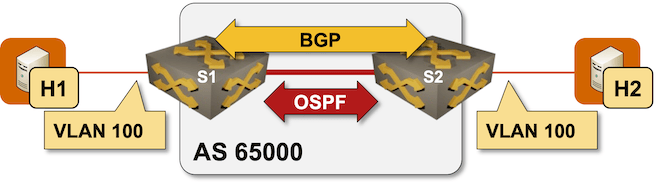
Ivan Pepelnjak is building on his VXLAN lab offerings by adding EVPN to the mix. - Ethan
MORE RESOURCES
From Gig City to Quantum City: The Value of Fiber Optic Infrastructure in Hamilton County, TN 2011-2035 (2025, 71 page PDF) - EPB of Chattanooga
INDUSTRY BLOGS & VENDOR ANNOUNCEMENTS 💬
Blue Origin Introduces TeraWave, a 6 Tbps Space-Based Network for Global Connectivity - Blue Origin News
https://www.blueorigin.com/news/blue-origin-introduces-terawave-space-based-network-for-global-connectivity
File under: doesn’t exist yet. But it sounds like it’s gonna be cool once the project gets off the ground in late 2027. So…two years from now, pretty much.
“The TeraWave architecture consists of 5,408 optically interconnected satellites in low Earth orbit (LEO) and medium Earth orbit (MEO). … Globally distributed customers can each access speeds of up to 144 Gbps delivered using Q/V-band links from a constellation of 5,280 LEO satellites, while up to 6 Tbps can be accessed via optical links from 128 MEO satellites.”
Who is this symmetrical bandwidth mix of RF & optical satellite network intended for? In large font, “TeraWave is Optimized for Enterprise, Data Center, & Government Customers.” Blue Origin expects about 100K max subscribers to the TeraWave constellation. I predict TeraWave won’t be budget-friendly whatsoever. I know I’d charge a lot to access it. - Ethan
Automate prefix lists with Amazon VPC IP Address Manager (IPAM) - AWS Networking & Content Delivery Blog
https://aws.amazon.com/blogs/networking-and-content-delivery/automate-prefix-lists-with-amazon-vpc-ip-address-manager-ipam/
AWS IPAM has gained a new feature to improve your network automation workflows: automated prefix-list generation.
“You can use this new feature to automate the setup and maintenance of VPC IP addresses across AWS services and resources so that your VPCs are ready to host workloads within minutes—a process that previously took days. In summary, this feature provides the following:
Automated connectivity management: Eliminate manual IP address/prefix synchronization across VPCs, security groups, and route tables
Reduced deployment time: Configure network connectivity in minutes instead of days
Minimized errors: Remove human error from repetitive IP address management tasks
Streamlined maintenance: Automatically update configurations when network changes occur”
The details post explains, with screenshots, how AWS IPAM managed prefixes work and how to configure it all. - Ethan
No Place Like Home Network: Disrupting the World's Largest Residential Proxy Network - Google Cloud Blog
https://cloud.google.com/blog/topics/threat-intelligence/disrupting-largest-residential-proxy-network
The Google Threat Intelligence Group went after the IPIDEA residential proxy network to make the Internet a better place. “What’s a residential proxy network?” you ask.
“In contrast to other types of proxies, residential proxy networks sell the ability to route traffic through IP addresses owned by internet service providers (ISPs) and used to provide service to residential or small business customers. By routing traffic through an array of consumer devices all over the world, attackers can mask their malicious activity by hijacking these IP addresses. This generates significant challenges for network defenders to detect and block malicious activities.”
While the use cases for residential proxies don’t have to be bad, they usually are.
“Google Threat Intelligence Group’s (GTIG) research shows that these proxies are overwhelmingly misused by bad actors. IPIDEA has become notorious for its role in facilitating several botnets: its software development kits played a key role in adding devices to the botnets, and its proxy software was then used by bad actors to control them. This includes the BadBox2.0 botnet we took legal action against last year, and the Aisuru and Kimwolf botnets more recently. We also observe IPIDEA being leveraged by a vast array of espionage, crime, and information operations threat actors.”
The blog details the steps GTIG took to clobber IPIDEA. GTIG also documented how the IPIDEA botnet works, including participating domain names and observed weaponized payloads. The piece concludes with a call to action for the security industry to get more aggressive to help thwart the growing threat of residential proxy networks. - Ethan
Lightyear automates the telecom procurement lifecycle. The company had a busy 2025, including launching an AI-driven telecom expense management offering, and embedding the capability to store, and visualize KMZ files to make it easier to see physical route details. (Note, they also recorded a sponsored Tech Bytes with us if that’s of interest.) - Drew
The Return of NetDevOps: Inside the Convergence of AI, Networking, and Automation - NetBrain
https://www.netbraintech.com/resources/the-return-of-netdevops/
NetBrain, which makes a network automation platform, commissioned a study by the Enterprise Strategy Group to gauge network professionals’ awareness of, and engagement with, NetDevOps, network automation, and AI. 400 networkers responded to the survey. The report looks at the most popular use cases for network automation, NetDevOps maturity levels, and more. You can get the full report at the link above with no need to enter any contact details. - Drew
Check Point has released its 2026 cyber security report. Check Point says its report provides “CISOs and security teams with the essential data, trends, and guidance shaping the year ahead. It synthesizes global threat intelligence drawn from large-scale attack telemetry, revealing how attackers operate and where defenses are most often bypassed.” It covers trends including AI as an attack vector, the ransomware economy, cyber attacks for warfare, and more.
You will need to sacrifice your contact details to the sales gods to access the report. - Drew
MORE INDUSTRY NOISES
From Intent to Impact: Building Production Network Agents in Minutes - Itential Blog
Introducing NetBox 4.5’s New Object Owner Functionality - NetBox Labs Blog
Drut Becomes Corespan Systems - Corespan Systems
From Stealth Blackout to Whitelisting: Inside the Iranian Shutdown - Kentik Blog
Route leak incident on January 22, 2026 - Cloudflare Blog
Breaking the networking wall in AI infrastructure (2025) - Microsoft Research Blog
Cisco Nexus 9000 Switches for Connecting Intel Gaudi 3 Accelerators Solution Overview (PDF) - Cisco Whitepapers
Operation Bizarre Bazaar: First Attributed LLMjacking Campaign with Commercial Marketplace Monetization - Pillar Security
DYSTOPIA IRL 🐙
TOO MANY LINKS WOULD NEVER BE ENOUGH 🐳
I still don't understand this SYN attack, but now I can block it easily - The Boston Diaries
Home Assistant Was Unable to Add IKEA Matter Devices - Major Network
Because coordination is expensive - Surfing Complexity
Booting from a vinyl record (2020) - BOGIN, JR
LAST LAUGH 😆

Shared by Dustin on the Packet Pushers Community Slack