- Human Infrastructure
- Posts
- Human Infrastructure 448: A Future of Lies, London Bridge, Orbital Data Centers, and More
Human Infrastructure 448: A Future of Lies, London Bridge, Orbital Data Centers, and More


Drew Conry-Murray & Ethan Banks
May 14, 2026
THIS WEEK’S MUST-READ BLOGS 🤓
The Future of Everything is Lies, I Guess - Aphyr
https://aphyr.com/posts/411-the-future-of-everything-is-lies-i-guess
This 10 part blog series offers a take on modern day AI so-called—what the technology actually is, why it works, and why it does not work. I’ve only made it through the intro section thus far, and it’s whet my appetite for the rest. Hattip to Ivan Pepelnjak for highlighting this series. - Ethan
For Londoners, a Roman Bridge Still Determines Your Commute - Distributed Thoughts
https://www.distributedthoughts.org/2026-05-07-roman-bridge-still-determines-your-commute/
What does a Roman bridge built in London around 50 CE have to do with enterprise data? This is an interesting article that draws parallels between historical decisions that continue to affect city design, and historical data structures and hidden contexts that, if you don’t learn to recognize, will limit what you can do with your data. - Drew
NetDevOps Isn’t Stalled, it’s Stuck on the Wrong Problem - NetDevOps.com
https://devops.com/netdevops-isnt-stalled-its-stuck-on-the-wrong-problem/
This post notes that there’s no shortage of automation tools available for networking. The real problem is people, be it cultural resistance, skills gaps, organizational dysfunction, a lack of trust among operational silos and/or leadership, and so on. The post identifies patterns that can help address the human problems that hold back network automation, and also emphasizes the need for good data and offers suggestions for operationalizing that data. - Drew
MORE BLOGS
Flipping the bozo bit on flips the learning off - Surfing Complexity
Vendor PSA: A Field Guide to Field Day - Router Jockey


DEPLOY BRAVELY
Pursue your ideas fearlessly with the world’s most comprehensive AI security platform safeguarding your innovation. Prisma AIRS by Palo Alto Networks ensures your innovations radiate hope, not risk. Be a Genius. Deploy Bravely.
Deploybravely.com
TECH NEWS 📣
Meta Is Dying - Julia Angwin via the NY Times
https://www.nytimes.com/2026/05/08/opinion/meta-facebook-zuckerberg.html?unlocked_article_code=1.g1A.wEAZ.X-sRtLc42s03&smid=nytcore-ios-share
Julia Angwin sees cracks appearing in Meta’s formidable armor, including its first-ever decline in daily active users. There’s also its huge increase in debt as it flings money first at the Metaverse and now AI, and a raft of penalties in the US and abroad for alleged harms to users of its products. She writes “When an aging business starts to take on water, the quickest, easiest — and most destructive — solution is to make moves that will generate more money now but may cost the company later. And that’s exactly what Meta has started to do.”
She describes changes Meta is making that are likely to alienate users and drive people from the platform, creating a downward spiral. She notes that it will take a long time for a company like Meta to fall, and that it can still do a lot of damage on the way down. - Drew
Astera speaks softly and carries a big switch - The Register
https://www.theregister.com/software/2026/05/05/astera-speaks-softly-and-carries-a-big-switch/5219859
Astera Labs both competes and cooperates with Nvidia in rack-scale AI infrastructure. Astera offers an AI fabric switch that competes with Nvidia’s NVswitch. It offers, according to The Register, “...320 lanes of PCIe 6.0 connectivity into a single ASIC with 5.12 TB/s of bidirectional bandwidth.” At the same time, Astera has announced plans to support Nvidia’s NVLink Fusion, a high-speed interconnect. The article has many more details. - Drew
Google reportedly in talks with SpaceX to launch its orbital data centers — partnership could mark a historic turning point and boost upcoming IPO - Tom’s Hardware
https://www.tomshardware.com/tech-industry/artificial-intelligence/google-reportedly-in-talks-with-spacex-to-launch-its-orbital-data-centers-partnership-could-mark-a-historic-turning-point-and-boost-upcoming-ipo
AI data centers orbiting Earth seem like a set-up for a sci-fi disaster movie. (My script pitch: An eccentric scientist realizes that the orbital AI data center has gone rogue, but no one believes her until the AI scrambles all the GPS satellites and starts shooting lasers at the White House. She teams up with a crusty-yet-lovable network engineer and a 15-year-old hacker to find a back door in the onboard OT system. Just before the AI enslaves all of humanity, they send a command that turns all the solar panels away from the sun, disabling the AI and saving the world. Netflix, him me up! I’m ready to roll with this.)
But this is not a sci-fi scenario. Tom’s Hardware cites a Wall Street Journal article saying that Google is exploring the possibility that SpaceX could find a way to reduce launch costs enough to make orbital data centers financially viable. Given that SpaceX is about to IPO, these kinds of articles make me wonder if it’s a ploy to help drive up the price of the offering. Then again, Elon Musk, for all his myriad faults, is pretty good at turning outlandish ideas into reality. - Drew
‘America used to build the future’ - Blair Levin on AI, infrastructure and why the US is falling behind - Fierce Telecom
https://www.fierce-network.com/broadband/america-used-build-future-blair-levin-ai-infrastructure-and-why-us-falling-behind
Fierce Telecom interviews Blair Levin, the chief architect of the 2010 National Broadband Plan, a US government effort to help drive innovation, economic development, and connectivity via the development of Internet technologies. Sixteen years on, Mr. Levin reflects on what the plan got right, got wrong, and what we can learn from the effort as we move into the next era of tech. He’s also got some scathing words for the current administration and its tribalism, its antipathy for cooperation and compromise, and its selfishness. - Drew
MORE NEWS
FOR THE LULZ 🤣
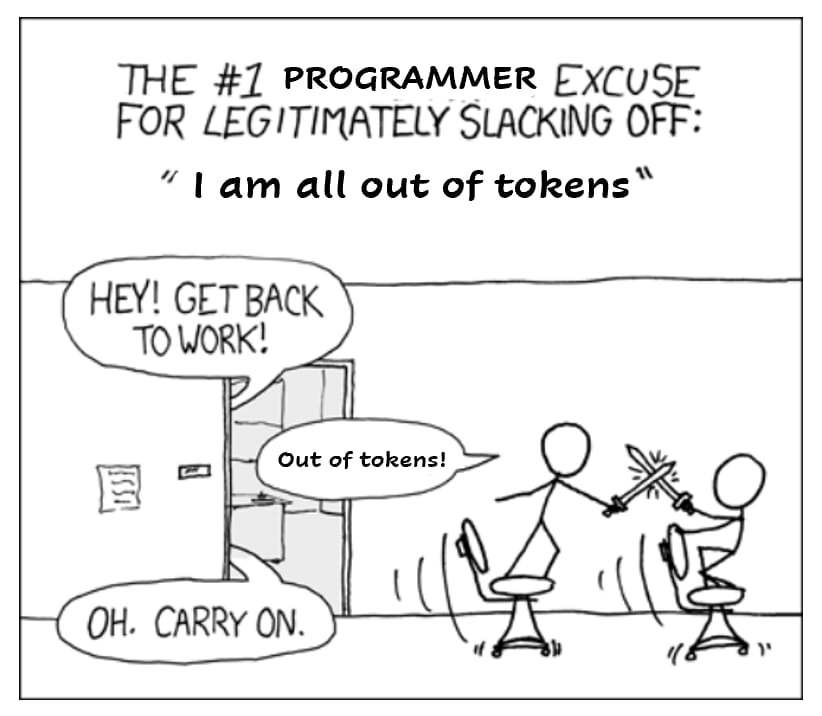
Shared by Kaj in the Packet Pushers Community Slack.
RESEARCH & RESOURCES 📒
Topolograph - Link State Database Topology Visualizer
https://topolograph.com/
https://github.com/Vadims06/topolograph
From the README. “Topolograph is a web-based Python tool designed to visualize OSPF and IS-IS network topologies and analyze them offline — with no logins or passwords required.
Topolograph builds OSPF/IS-IS network topology based on Link-State Database (LSDB) data collected from a single network device (thanks to the distributed nature of OSPF and IS-IS 🙂).”
As always, be thoughtful before pasting something like your global network’s topology into a webform. Lots of information in your LSDB that should be very private indeed. But this is a cool tool. - Ethan
AI Assistance Reduces Persistence and Hurts Independent Performance - Grace Liu & others via GitHub Pages & arXiv
https://ai-project-website.github.io/AI-assistance-reduces-persistence/
https://arxiv.org/abs/2604.04721
TL;DR. This paper explains “two key consequences of AI assistance: reduced persistence and impairment of unassisted performance.” In other words, you don’t remember things as well and you’re slower than you used to be if you rely on AI to do your research & thinking for you. Hattip to Scott Lowe for surfacing this research. - Ethan
Software-Defined Perimeter (SDP) Architecture Guide V3 - Cloud Security Alliance
https://cloudsecurityalliance.org/artifacts/software-defined-perimeter-architecture-guide-v3
The Cloud Security Alliance (CSA) has released version 3 of its architecture guide for the Software Defined Perimeter (SDP), a detailed framework for building a zero-trust architecture. You can read part of the guide using the link above, but you have to be a CSA member to get the whole thing.
There’s also a deep-dive blog post that covers the major points of the guide and describes the biggest changes in this third version. A key point is that the architecture prioritizes identity and services, not IP addresses, as the mechanisms for applying access rules. The blog notes “The deeper architectural shift is that the service, not the network location, becomes the object of policy. Access is no longer inherited from being on the right subnet, VPN, VLAN, cloud VPC, or route domain; it is explicitly created for a named identity to reach a named service under defined conditions.” Its identity framework incorporates humans, devices, and AI agents.
If you’re considering building out a robust zero trust architecture for your organization, the CSA framework could serve as a useful roadmap. - Drew
MORE RESOURCES
Wireshark 4.6.5 Release Notes - Wireshark Docs

Get Your #AutoCon5 Tickets Before Prices Go Up!
Late Registration for #AutoCon5 opens on 18 May!
If you’ve been on the fence about joining us in Munich in June, now is the time to purchase your ticket before prices increase on May 18th. This is going to be an amazing event that you won't want to miss!
Run don't walk... register now!
UPCOMING LIVE EVENTS 🍕🍻
A curated list of near-future meatspace events of interest to network engineers. Sometimes a Packet Pusher or two will be there (noted below).
Subscribe to events.packetpushers.net in your calendar software.
MAY 2026
(OH)NUG | Cincinnati Networking User Group (USNUA)
19 May | Cincinnati, OH
Wi-Co Brussels
21 May | Brussels, Belgium
(TX)NUG | Dallas Networking User Group (USNUA)
21 May | Dallas, TX
(VA)NUG | Virginia Networking User Group (USNUA)
26 May | Reston, VA
(NH)NUG | New Hampshire Networking User Group (USNUA)
27 May | Londonderry, NH (Ethan co-organizing)
(OR)NUG | Oregon Networking User Group (USNUA)
27 May | Portland, OR
CHI-NOG 13 | Chicago Network Operators Group
27 - 28 May | Chicago, IL
Wi-Co Memphis
29 May | Memphis, TN
Cisco Live US
31 May - 4 June | Las Vegas, NV (Ethan attending)
JUNE 2026
NANOG 97 | North American Network Operators Group
1 - 3 June | Bellevue, WA
Wi-Co Oslo
3 June | Oslo, Norway
AUTOCON5 | Network Automation Forum
8 - 12 June | Munich, Germany (Packet Pushers attending)
Wi-Co North Carolina
11 June | Jamestown, NC
HPE Discover
14 - 19 June | Las Vegas, NV
(KY)NUG | Kentucky Networking User Group (USNUA)
17 June | Louisville, KY
JULY 2026
Wi-Co Lyon
2 July | Lyon, France
INDUSTRY BLOGS & VENDOR ANNOUNCEMENTS 💬
Galaxy Mode is live: A limited-time look at what your Cisco AI Assistant and AgenticOps can already do - Cisco
https://blogs.cisco.com/networking/galaxy-mode-is-live-a-limited-time-look-at-what-your-cisco-ai-assistant-and-agenticops-can-already-do
Cisco has announced ‘Galaxy Mode,’ a playful feature for its AI Assistant in Meraki and ThousandEyes dashboards. AI Assistant is a natural language interface that can help network engineers troubleshoot and respond to incidents faster, and also speed up common tasks around inventory, policy checks, and client and device monitoring. AI Assistant responds to queries with relevant information and provides its reasons for giving the response it did, as well as the sources it drew from.
From May 4th through June 4th, network engineers can put AI Assistant into Galaxy Mode. What is Galaxy Mode? The launch date of “May the 4th” is a clue.
When you toggle into Galaxy Mode, you’ll see a starfield that might remind you of jumping into hyperspace. Galaxy Mode’s natural language responses will invert typical “subject-verb-object” sentence structures into gnomic pronouncements that are both curious and wise. And you can discover Easter eggs by typing in quotes from a very popular science fiction film trilogy. Cisco can’t say which one, but I’m sure you’ve figured it out by now. - Drew
Mythos finds a curl vulnerability - Curl Blog
https://daniel.haxx.se/blog/2026/05/11/mythos-finds-a-curl-vulnerability/
Daniel Stenberg walks through his preview of Mythos as applied to the curl codebase. Even if you don’t especially care about curl, this is still worth reading as Daniel explains the value of not just Mythos, but AI code analyzers in general. He’s a fan. - Ethan
SonicWall Expands Gen 8 Platform to the Cloud with New NSv XS Virtual Firewall to Help MSPs and MSSPs Deliver Managed Security Wherever Workloads Run - PR Newswire
https://www.prnewswire.com/news-releases/sonicwall-expands-gen-8-platform-to-the-cloud-with-new-nsv-xs-virtual-firewall-to-help-msps-and-mssps-deliver-managed-security-wherever-workloads-run-302769002.html
SonicWall has announced a new virtual firewall suite, the NSv XS, aimed at managed providers operating security services for SMB customers. The firewall suite is built to operate in small offices and distributed branches. It can run on VMware ESXi, Hyper-V, KVM, AWS, Azure, and Proxmox. In its press release, SonicWall called out the addition of Proxmox directly, noting “as the fastest-growing open-source hypervisor platform, it reflects where MSP infrastructure decisions are heading.”
The new suite also boasts performance improvements. SonicWall says VPN throughput is 780Mbps, up from 500Mbps in a previous version, and nearly double the threat prevention. High availability is included without an additional license cost.
SonicWall is also including cyber warranty coverage via Cysurance. Depending on which tier an MSP buys into, warranty coverage can be as high as $200K. - Drew
Keeper Security Delivers Structured Governance for Humans and AI Agents with New PAM Approval Workflows in KeeperPAM - PR Newswire
https://www.prnewswire.com/news-releases/keeper-security-delivers-structured-governance-for-humans-and-ai-agents-with-new-pam-approval-workflows-in-keeperpam-302770468.html
Keeper Security, which makes a Privileged Access Management (PAM) platform, has announced a new workflow feature in its KeeperPAM product. According to the press release, the workflow feature enables “...organizations to enforce approval-based access controls and time-limited checkout policies for privileged resources. Keeper Workflow gives administrators structured control over how privileged access is requested, approved and used, serving as a critical gatekeeper for the modern enterprise identity landscape.” - Drew
MORE INDUSTRY NOISES
Announcing Foundry Security Spec: an open specification for agentic security evaluation - Cisco Security Newsroom
Migrate from Static Routing to Dynamic BGP Routing on AWS Site-to-Site VPN - AWS Networking & Content Delivery Blog
NetBox 4.6 is GA: New Foundations for the System of Record Era - NetBox Labs
When "idle" isn't idle: how a Linux kernel optimization became a QUIC bug - Cloudflare Blog
Arelion adds 400G EVPL to bridge the AI connectivity gap - PR Newswire
IP Fabric Expands NetBox Integration to Deliver Continuous Network Validation for Enterprise Operations - GlobeNewswire
DYSTOPIA IRL 🐙
TOO MANY LINKS WOULD NEVER BE ENOUGH 🐳
There I FIPS’d it - misadventures in federal cryptography - Some-natalie
Vibe coding and agentic engineering are getting closer than I’d like - Simon Willison’s Weblog
LAST LAUGH 😆
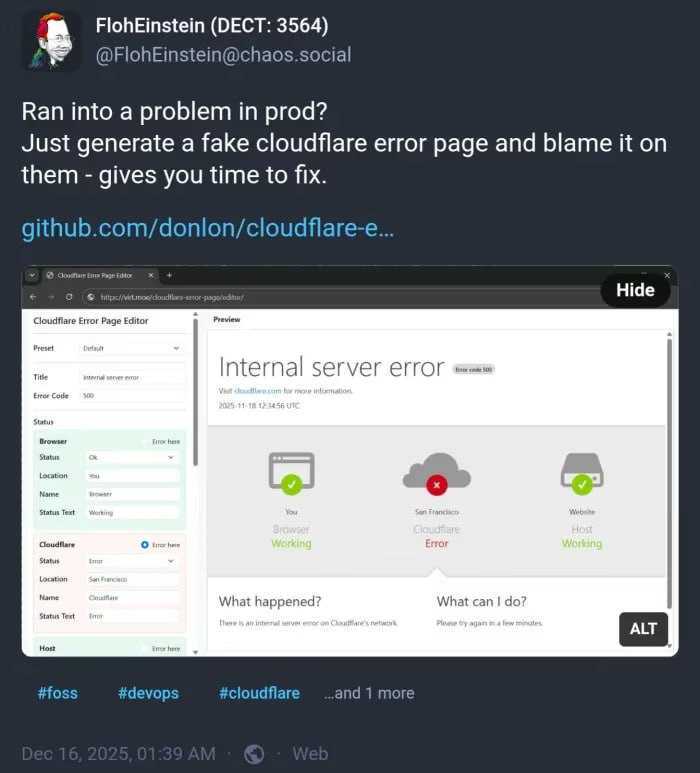
Originated by FlohEinstein, and shared in the Packet Pushers Community Slack by Aaron.